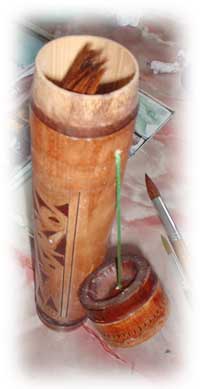
One of the greatest challenge facing a new painter is finding a suitable subject to paint. I have been asked, often, what is the best subject to paint: still life or scenery.
To me, it doesn't really matter. If you like it, anything can be a subject. The important thing is you must have a passion in wangting to paint just about anything and I am sure anything is interesting enough if you set your eyes on it to capture your subject, be it people at the market, a lone fisherman in his moment of soliquy as he wait for the first bite or even a tray of fruits on the altar.
My approach is usually to take observe anything and imagine how I would paint it. If I were to have a pencil (or pen) with me, a piece of paper or my notepad, I will immediately sketch out the forms and the colour values. I think this is how painters, beginners especially, should start.
 By improving one's drawing skills, sharpening one's observation powers, can one ever hope to paint well. Painting is but putting what is before you in paper, at least that is what I think is for me. The tough part is drawing. Many paintings have been a casualty of poor drawing techniques.
Take a look at some of the greatest artists and I would like to quote John Singer Sargeant whose watercolour works are exquisitely simple but masterpieces. Sargeant was very detailed in his sketches as you can see in some of his works.
Pictures: Sargeant's Study for Apollo and the Muses (top right) and Game of Chess (top left) available at the Adelson Galleries.
Nearer to home, we have Yong Mun Sen, (1896 - 1962) who has sometimes been referred to as the “father of Malaysian art”, a title I think he truly deserves.
Yong, whose life's works were depicted in his tribute exhibition catalogue by the Penang Art gallery in the late 90s, was also a meticulous painter who has a knack of recording his subjects in detailed drawings.
Be it rubber tappers at work or a tin dredge, Yong has successfully documented various aspects of Malaysian life in his art.

One of his exquisite works, the Dredge, is now in the collection of the Petronas Art Gallery. The piece, entitled Sungai Melaka (1953) (above) , depicts the artist's fascination with life - in this case the daily routine of traders along the Malacca River after the war.
As a beginning painter, I think it is good to start by cultivating this drawing habit. Only when you can draw well, can you paint well.