Tuesday, August 01, 2006

Meet Rafie Abdul Rahman - The Smiling Artist


I got to know En Rafie a year ago when I assisted him in putting up his stall at the monthly art bazaar - Laman Seni - at the National Art Gallery. I was attracted to his 'theoretically-correct' watercolours and we spent sometime discussing art, particularly watercolours.

His children having grown up, he now has more time on his hands to paint. He retired from his profession as a building supervisor several years ago, I was told. Today, he paints, exhibits and gives classes to children and adult.

En Rafie is a self-trained artist with lots of experience. From the old school, his works have been collected by renowned galleries. Apart from watercolours, he also does Chinese brush and oils. However, I find that his watercolour pieces are his best and remarkably vibrant. As you can see from this piece which he called 'Jungle Scene' which he painted while manning his stall at Putrajaya's Laman Seni recently.
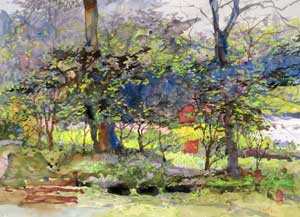
The painting, according to him, was almost spoilt but despite it being a watercolour medium, his vast experience has managed to salvage it and turn it into an enviable work of art.

En Rafie also gives watercolour classes and if you like to be under his tutelage, let me know.

Tuesday, July 25, 2006

What do you do when inspirations dry up?


As a painter, this is one of the most dreaded moments. For some reason or the other, there will come a time when you simply cannot put your thoughts on paper and turn that observation into a piece of art that you used to.

It can follow a personal crisis or during a particularly stressful period that concerns your working life. This is especially true when you are working full time and painting part-time. So what do you do?

In my personal experience, when you are faced with such a time, the best thing is to lay off your painting sets a while, maybe for a day or two. It will be a good thing not to force youself to paint because if you do, and the work comes out bad, you will be more disappointed with it than if you had not drawn or painted anything. And it just might be the trigger that you could abandon your work, for good.

On the extreme side of it, if you did not paint during a lull period, you might become too lazy to pick up the brush again, and end up abandoning your greatest love of all. Which is sad.

So, as a watercolourist, what do you do? Or rather, as an artist, when is your next logical step?

For me, I don't know about you and your methods may differ greatly, I normally change to sketchings and doodles. Sometimes, I even get hold of some pastel colours and start doing doodles as I would with watercolour of the things I see.

I would never pay much attention to the work, just sketching and doodling as I go, capturing only the shapes and colours, paying no special attention to getting everything right. This way, I found out, keeps my drawing instincts intact. It may come out as a work or art, or it may turn out to be rubbish.

Either way, you exercise your thoughts and keep them in good shape despite having a lull period. And when you have gained proper perspective to your woes, you will easily pick up your brush and paint that masterpiece again. Believe me, it works.

Have a good day - painting or otherwise!

Technorati Tags: art, watercolour,instruction,lessons